Wood (HTX)
39″ panel max
1 panel (36″ wide)
Saves 4″ of view

Plantation shutters feature five key styling components: louver size, tilt control, paint color, split-tilt, and frame profile. At HTX Shutters, all five are included at no extra cost. Each section below explains the option, shows what most of our clients choose, and helps you decide. The shutter design principles that follow cover how we build our wood shutters differently, so the finished shutters look cleaner and work better. The styling FAQs at the end of the page answer the questions we hear most often.
2.5", 3.5" or 4.5" wide slats
Our pick: 4.5" louvers for a modern aesthetic, which 62% of our clients choose for their homes. Choose 3.5" louvers for a more traditional look or with jambs shallower than 2.5", and 2.5" louvers only where the jamb is under 2" deep.
Louvers are the horizontal slats that rotate to open and close a shutter. Wider louvers let in more light, put fewer lines across your view and make cleaning easier. However, each louver size needs a minimum jamb depth (2.5" for 4.5" louvers, 2" for 3.5", 1.9" for 2.5") and each louver size suits a different range of window heights. Larger louvers are considered to be more modern or contemporary than smaller louvers. About 36% of our clients choose 3.5" louvers, and the remaining 2% choose 2.5" louvers, mostly for Heights, Bellaire and West University homes where the window jamb is too shallow for wider slats.
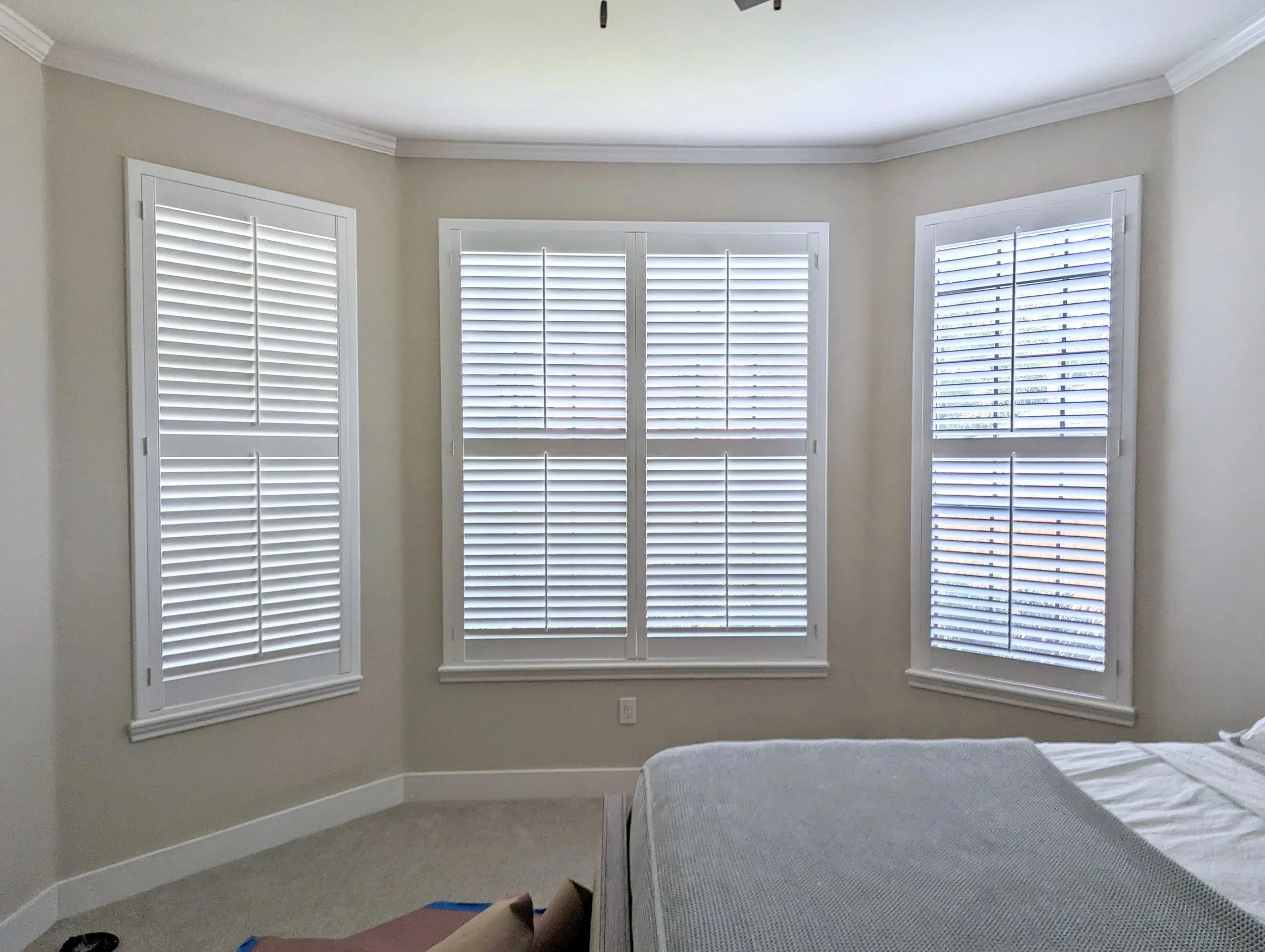
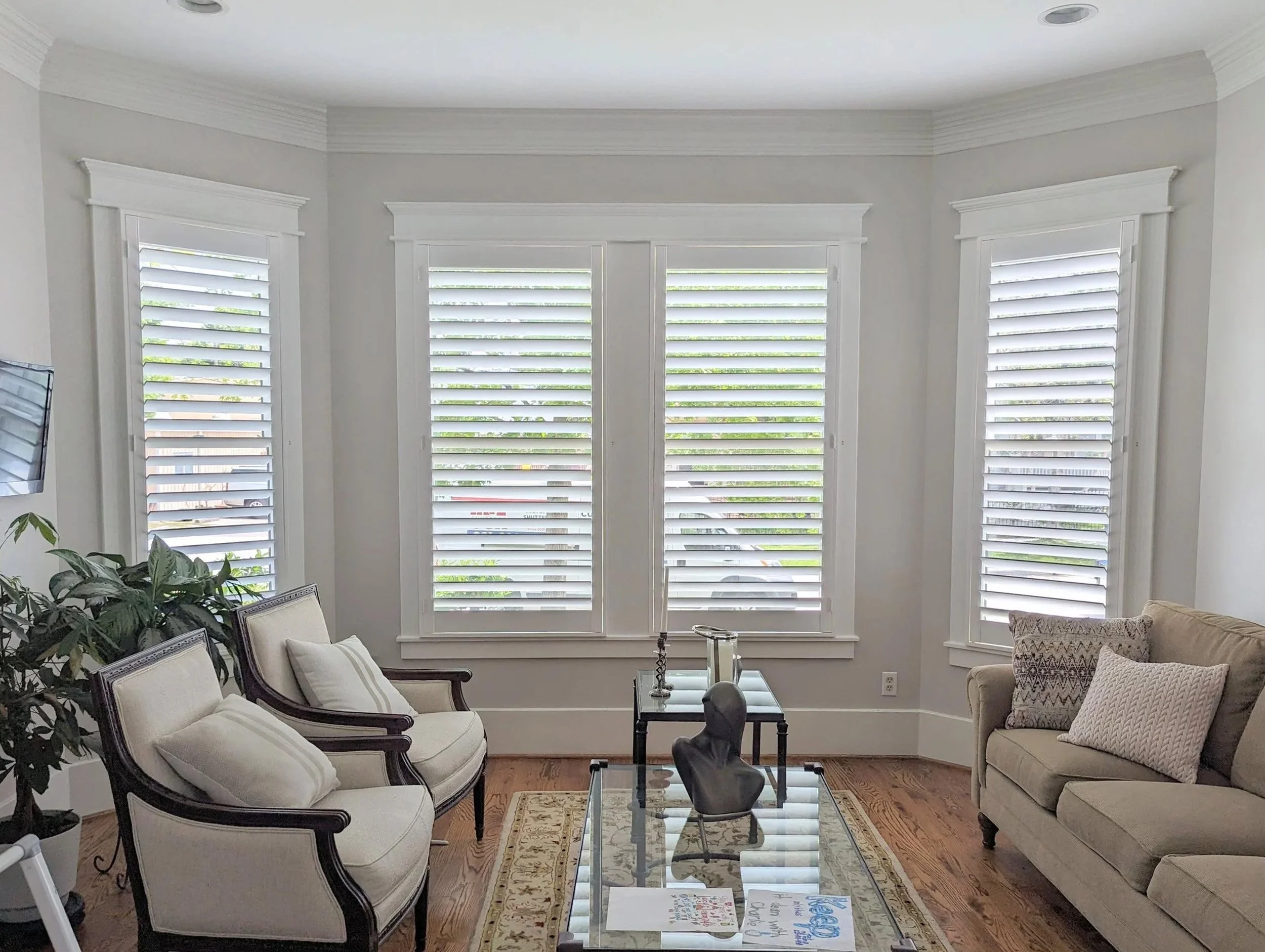
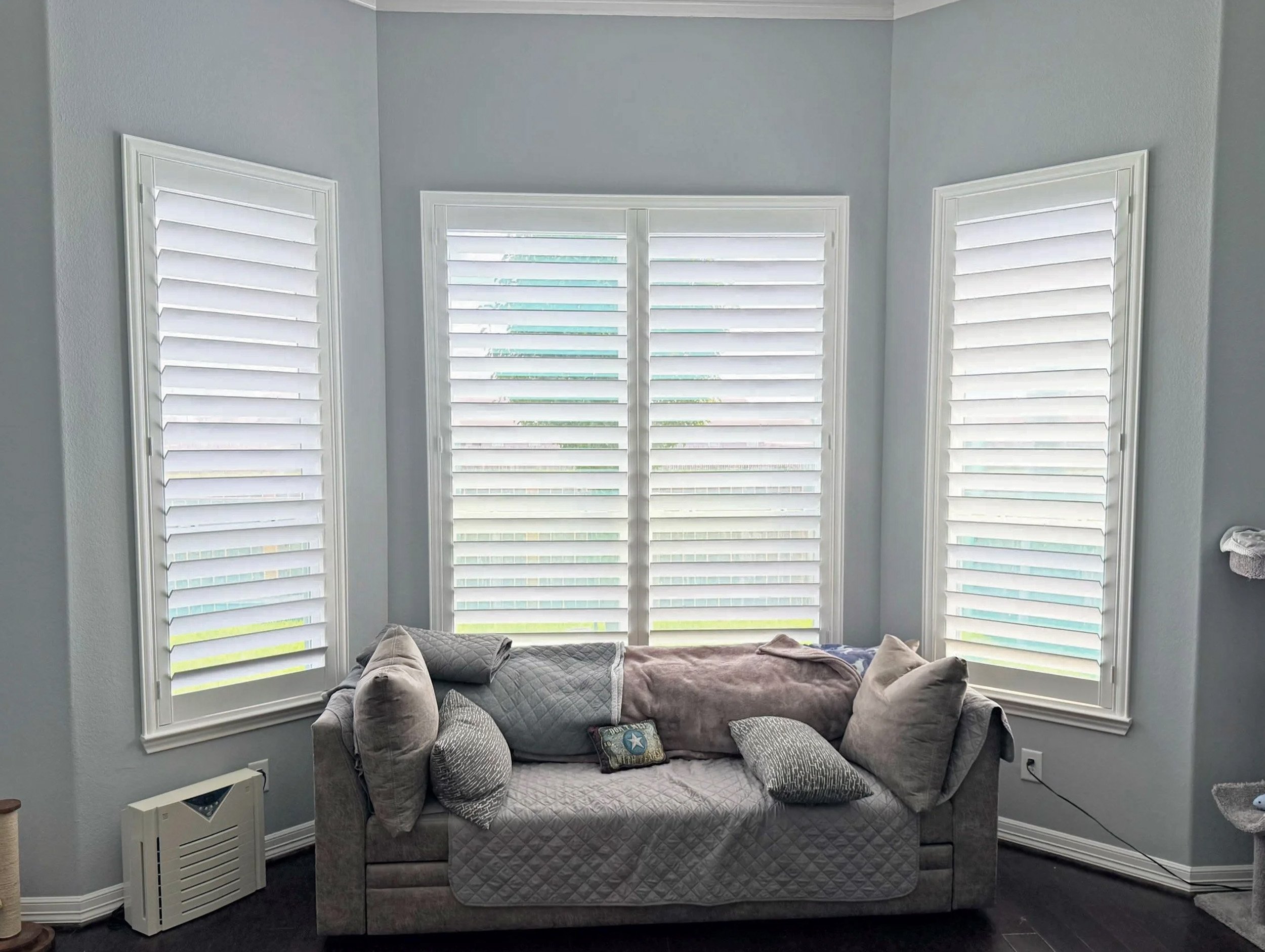
| Louver | Popularity | Min. jamb depth | Best window heights | Slats to look through | Usual tilt pairing | Feel |
|---|---|---|---|---|---|---|
| 2.5" | 2% | 1.9" (L-frame) | 22"–59" | Highest (2x the 4.5") | Front/center | Elegant, time-honored |
| 3.5" | 36% | 2" (Z-frame) | 22"–70" | 33% fewer than 2.5" | Either | Refreshed, charming |
| 4.5" | 62% | 2.5" (Z-frame) | 35"–94"+ | 50% fewer than 2.5" | Rear/hidden | Uncluttered, sleek |
 2
2
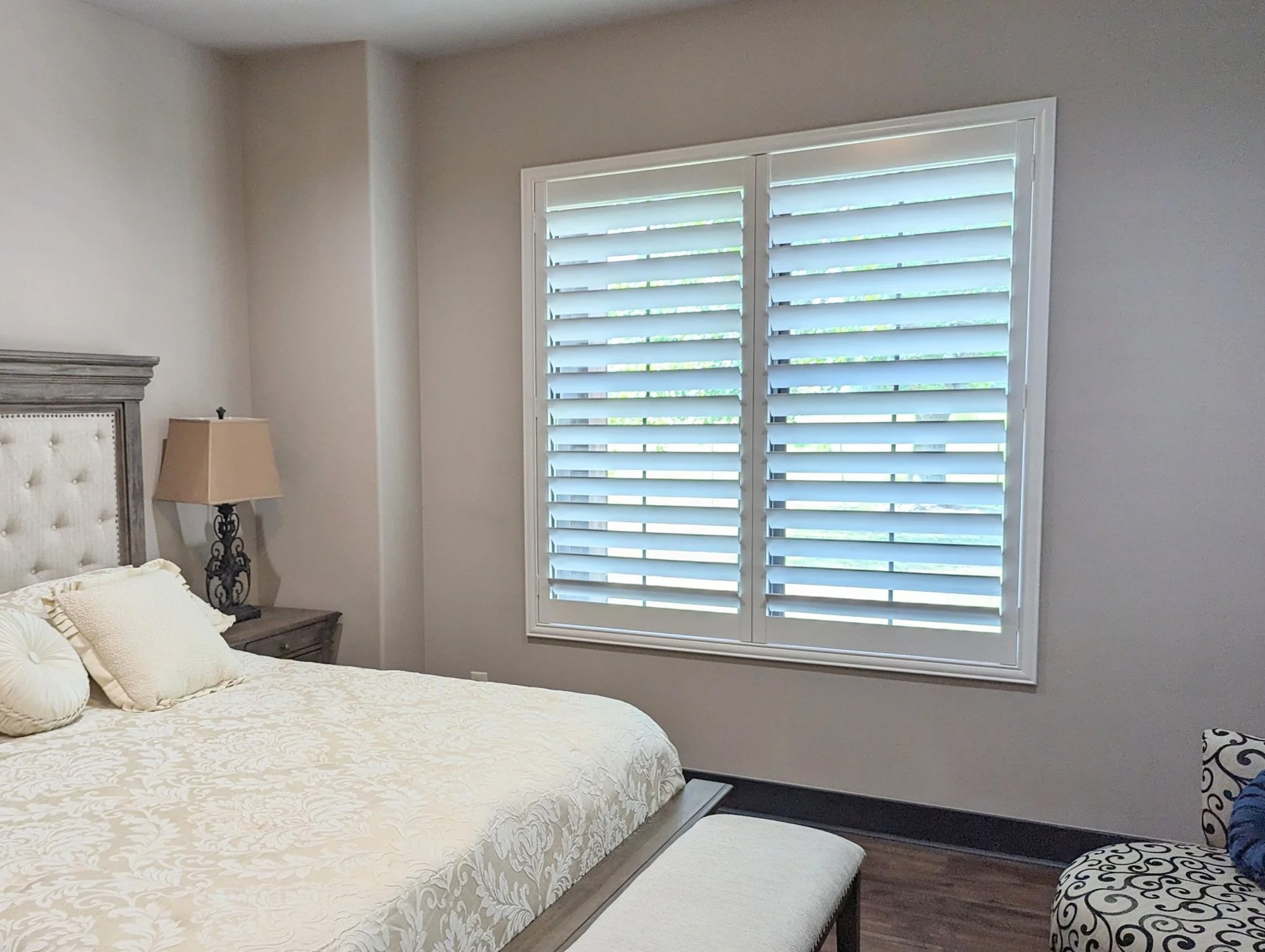
Front/center or hidden/rear tilt rod
Our pick: Rear/hidden tilt, which 92% of our clients choose for the cleaner look, easier cleaning and better durability. Choose a front/center tilt only when you want a traditional, historic-home look.
The tilt rod links the louvers so they rotate together. A front/center tilt rod runs visibly down the center of the panel; a rear/hidden tilt rod sits on the back and stays out of the view. The durability difference comes from the hardware: front rods attach to each louver with staples that can pull loose over time, while hidden tilt needs no maintenance. Front/center tilt is considered more traditional, whereas rear/hidden tilt is a more modern choice.
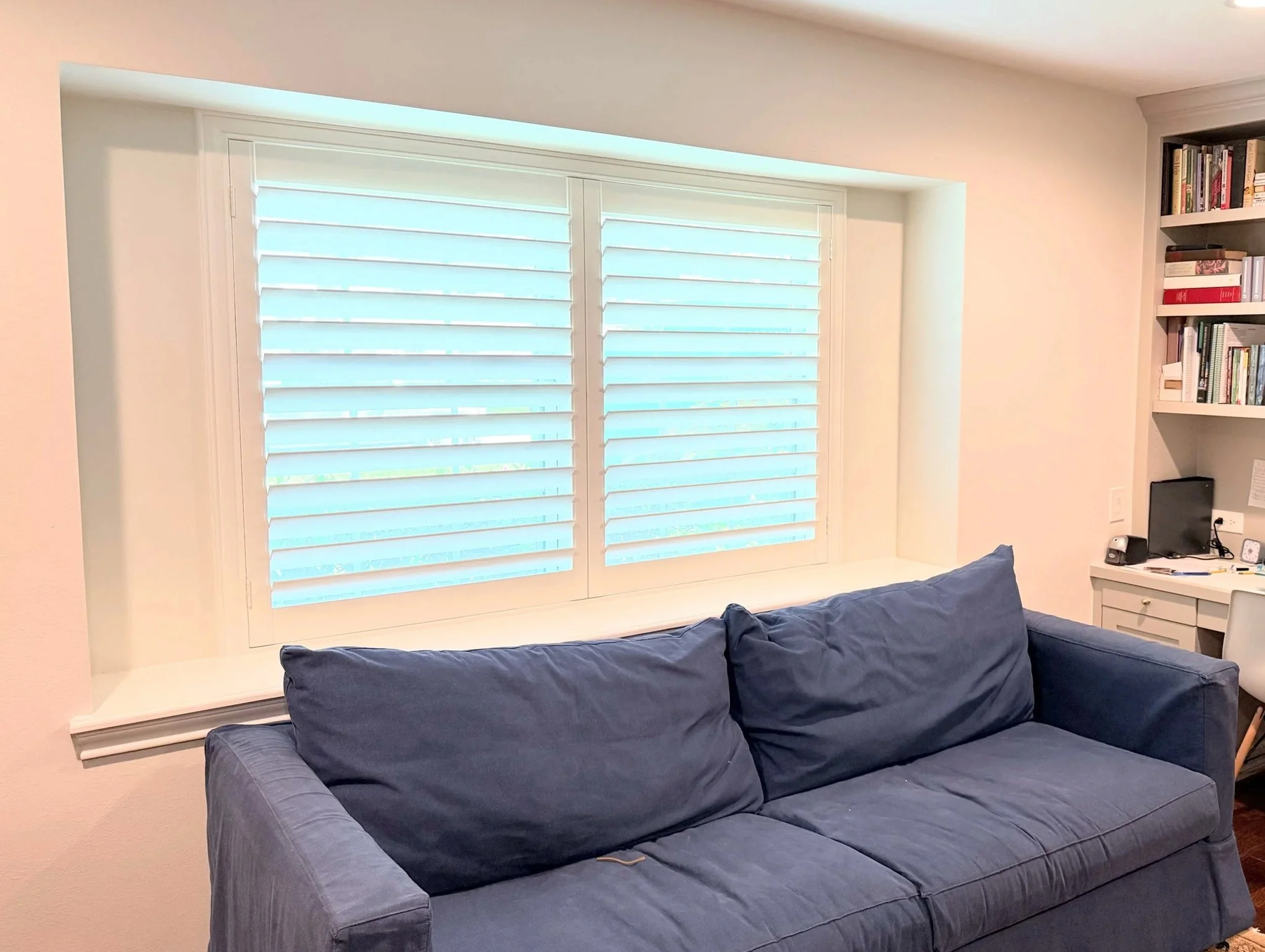
| Tilt rod | Popularity | Look | View | Cleaning | Durability | Light seal | Common in |
|---|---|---|---|---|---|---|---|
| Front/center | 8% | Classic, traditional | Rod down the center | Slightly harder | Handle with care (stapled) | Slightly tighter | Ranch, craftsman, historic homes |
| Rear/hidden | 92% | Minimalist, modern | Unobstructed | Easier | More durable, zero maintenance | Standard | Townhouses, custom homes |
 ∞
∞
Any Sherwin-Williams color
Our pick: Match your existing trim, not your walls. We scan your trim with a spectrophotometer and paint to any Sherwin-Williams color - Extra White (SW 7006) is commonly selected by 45% of our clients, followed by High Reflective White at 21%.
Shutters look best when the paint matches the window sill or casing trim they sit against. When compared side by side, even a slightly different white can look like a mismatch and make the shutter look like an afterthought. We scan your trim with a commercial spectrophotometer, match the reading to the closest Sherwin-Williams color, then confirm the match by eye.
The brightest white from Sherwin-Williams. Choose it when you want shutters to match bright-white trim exactly. 21% of HTX Shutters clients choose High Reflective White for their plantation shutters.
View High Reflective White on Sherwin-Williams.comA crisp, cool white and our most-requested shutter paint color. Pairs cleanly with white trim and modern interiors. 45% of HTX Shutters clients choose Extra White for their plantation shutters.
View Extra White on Sherwin-Williams.comA soft, balanced white with a hint of warmth. A safe match for many existing trim colors. 14% of HTX Shutters clients choose Pure White for their plantation shutters.
View Pure White on Sherwin-Williams.comA quiet white with a faint gray undertone. Works well when walls are a cool neutral. 7% of HTX Shutters clients choose Snowbound for their plantation shutters.
View Snowbound on Sherwin-Williams.comA warm, creamy white that displays gently against natural light. Popular with farmhouse and transitional homes. 2% of HTX Shutters clients choose Alabaster for their plantation shutters.
View Alabaster on Sherwin-Williams.comChoose any color from Sherwin-Williams — no charge for whites, light greys or light beiges. 11% of HTX Shutters clients choose custom colors for their plantation shutters.
View custom colors on Sherwin-Williams.com| Color | SW number | Popularity | Character | Best match for |
|---|---|---|---|---|
| High Reflective White | SW 7757 | 21% | Brightest SW white | Bright-white trim |
| Extra White | SW 7006 | 45% | Crisp, cool white | White trim, modern interiors |
| Pure White | SW 7005 | 14% | Soft, balanced, hint of warmth | Warm white trim colors |
| Snowbound | SW 7004 | 7% | Quiet white, faint gray undertone | Cool-neutral walls |
| Alabaster | SW 7008 | 2% | Warm, creamy white | Farmhouse, transitional homes |
| Custom | Any SW color | 11% | Varies by color | Matching your existing trim exactly |
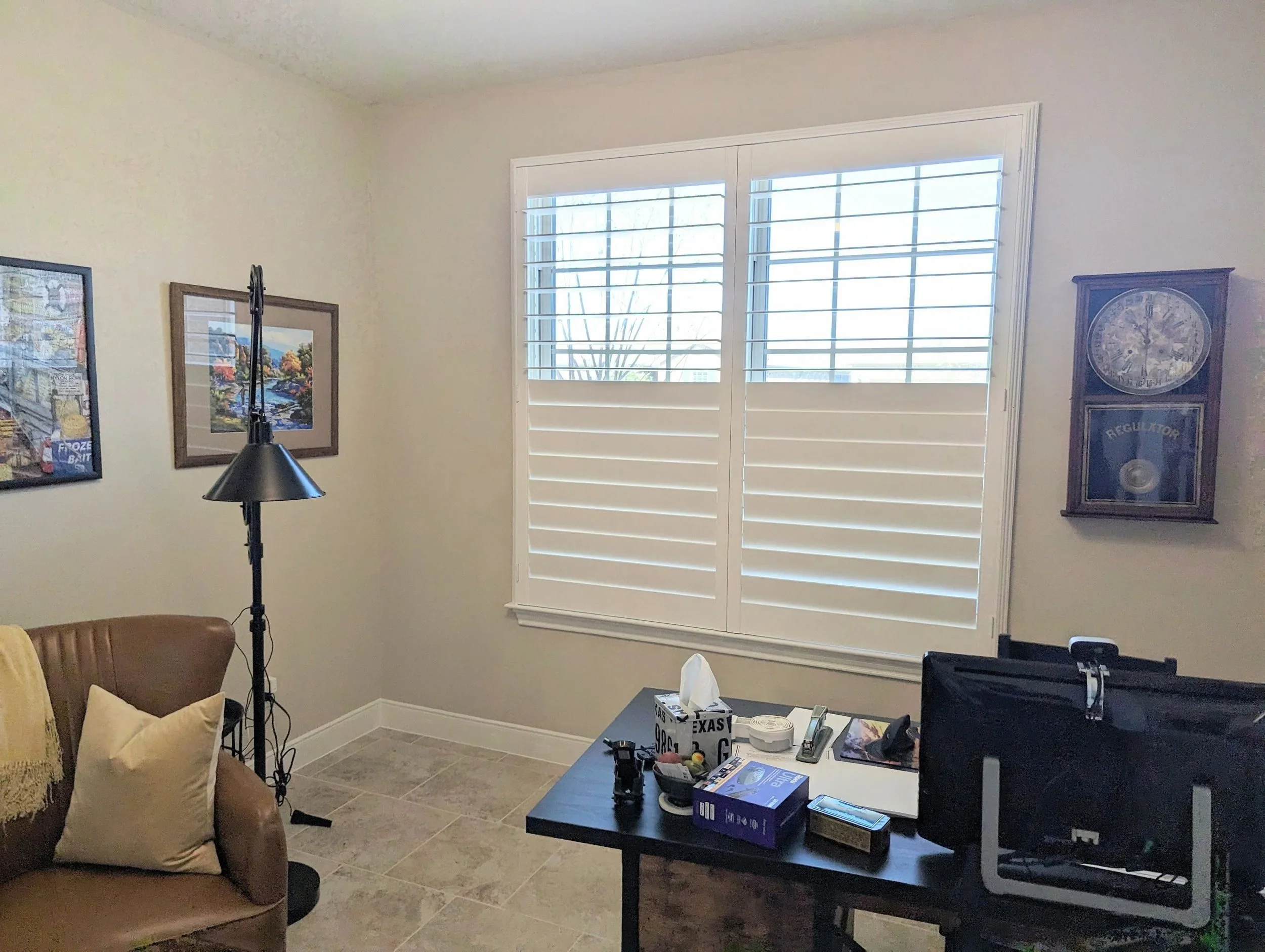
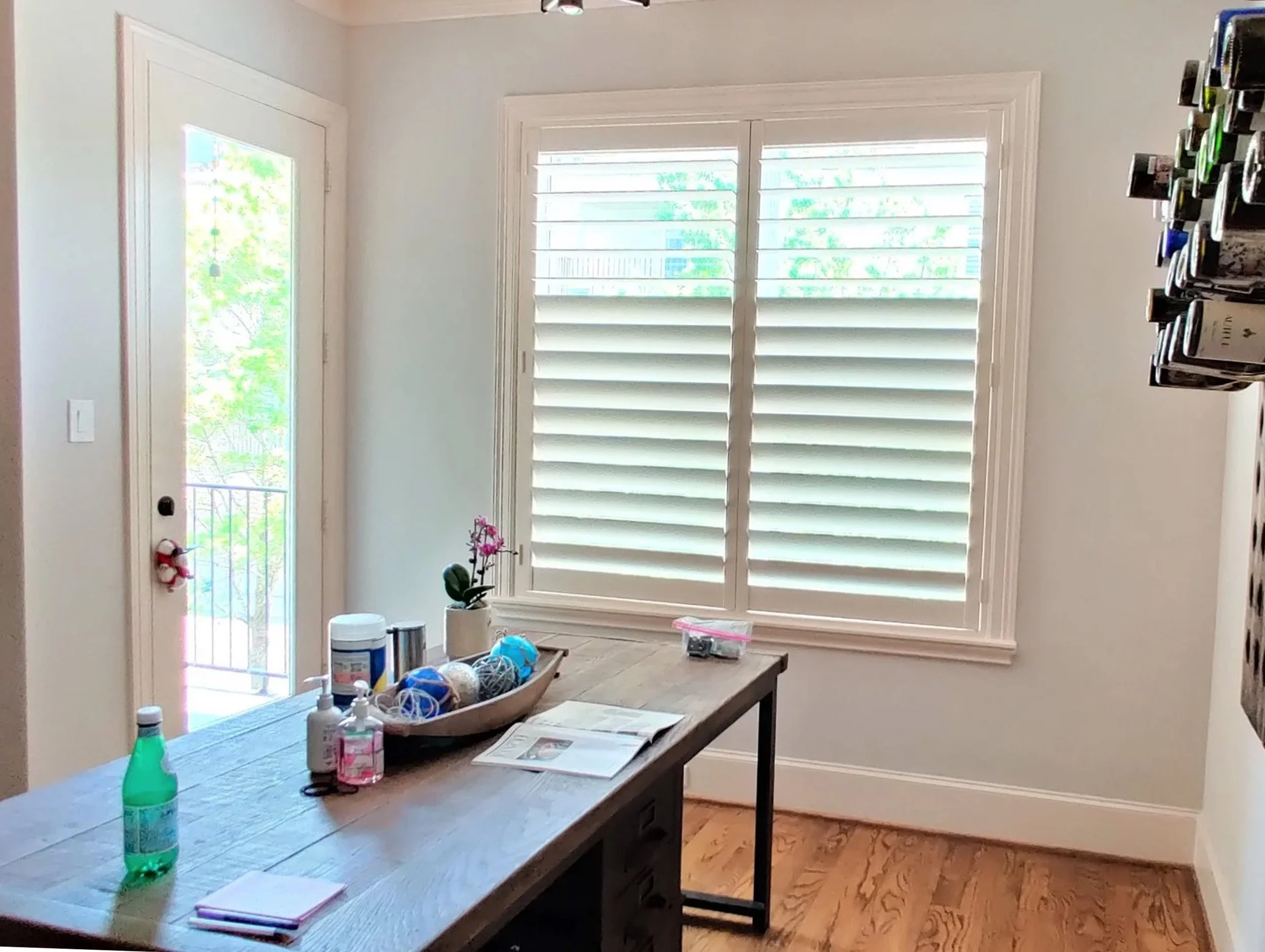
50/50, 33/67 or no split
Our pick: Split-tilt where privacy matters — 33/67 for bedrooms on windows 70" or taller and 50/50 for windows 35" - 69" tall. "No split" is chosen 41% of the time, for windows not needing privacy or windows shorter than 35". Common shutters that are not specified as split-tilt are front entry sidelights, upper transom windows and doors.
Split-tilt divides a shutter's louvers into upper and lower sets that tilt independently, so you can close the bottom for privacy while the top stays open for light. Because our panels don't need a fixed middle divider rail, the split point can go wherever it works best without a solid divider bar blocking the view. The 33/67 split provides a larger bottom section and the most privacy control, while 50/50 gives more light up top. Larger windows benefit the most from split-tilt, since they have more louvers available to split across multiple sets. "No split" is a reasonable option if you have smaller windows, want fewer sets of louvers to operate, or if you want to ensure all louvers of a shutter are always at a consistent angle. There are six main considerations when selecting split-tilt: window height, distance of window from the ground, privacy needs, height of room occupants, vantage points of neighboring windows, and degree of preexisting privacy from trees or fences.
| Split | Popularity | Best window heights | Privacy vs. light | Reach | Common rooms |
|---|---|---|---|---|---|
| 50/50 | 35% | 35" and above | Balanced; privacy and light control | Top louvers easy to reach | Bedrooms, living rooms, dining, offices |
| 33/67 | 24% | 70" and above | Maximum privacy control (larger bottom) | Top louvers may be hard to reach | Bedrooms, bathrooms, breakfast nooks, media rooms |
| No split | 41% | 83" and below | All louvers move together | Easiest | Most room types |
 7
7
Profiles from traditional to modern
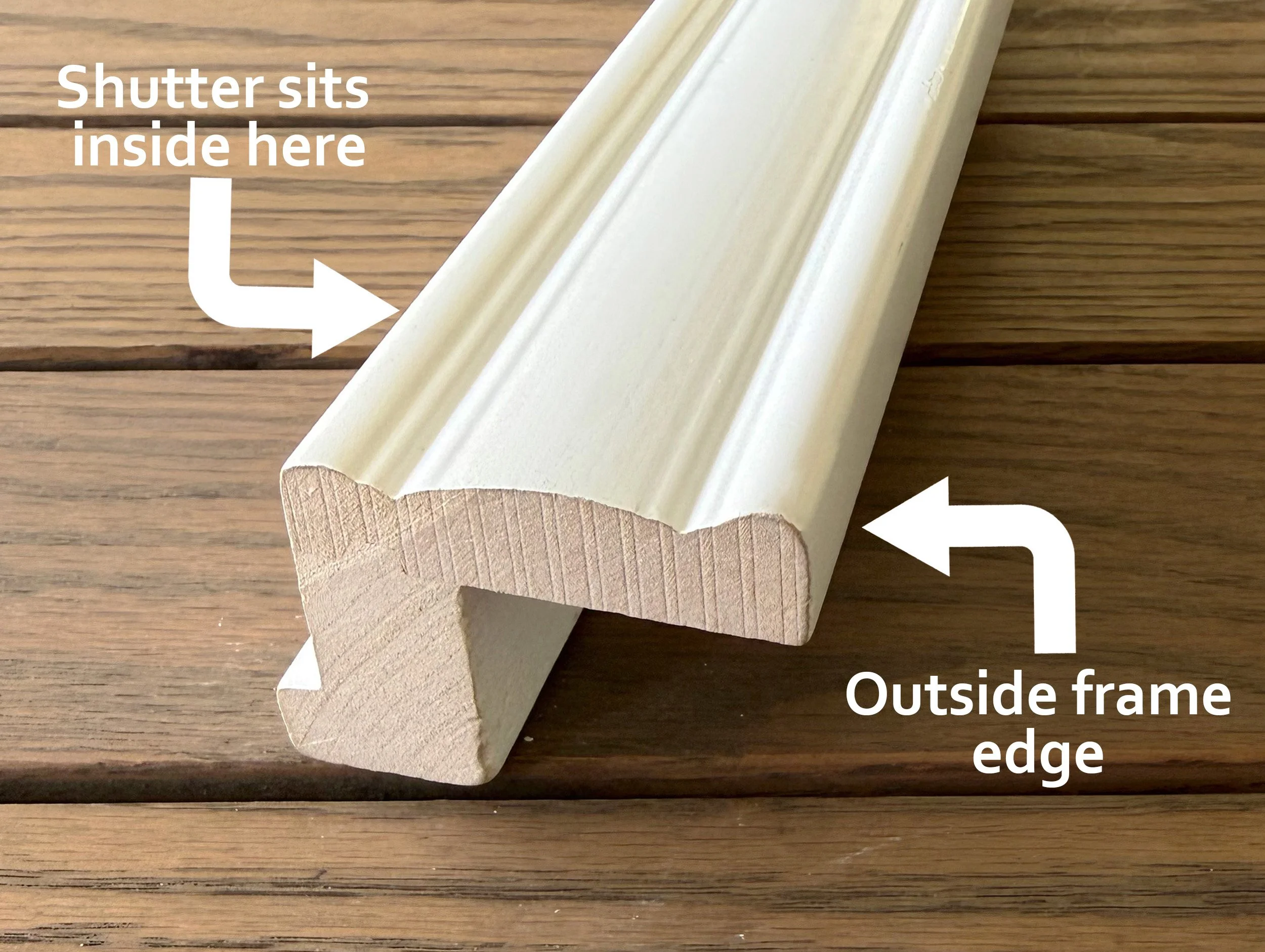
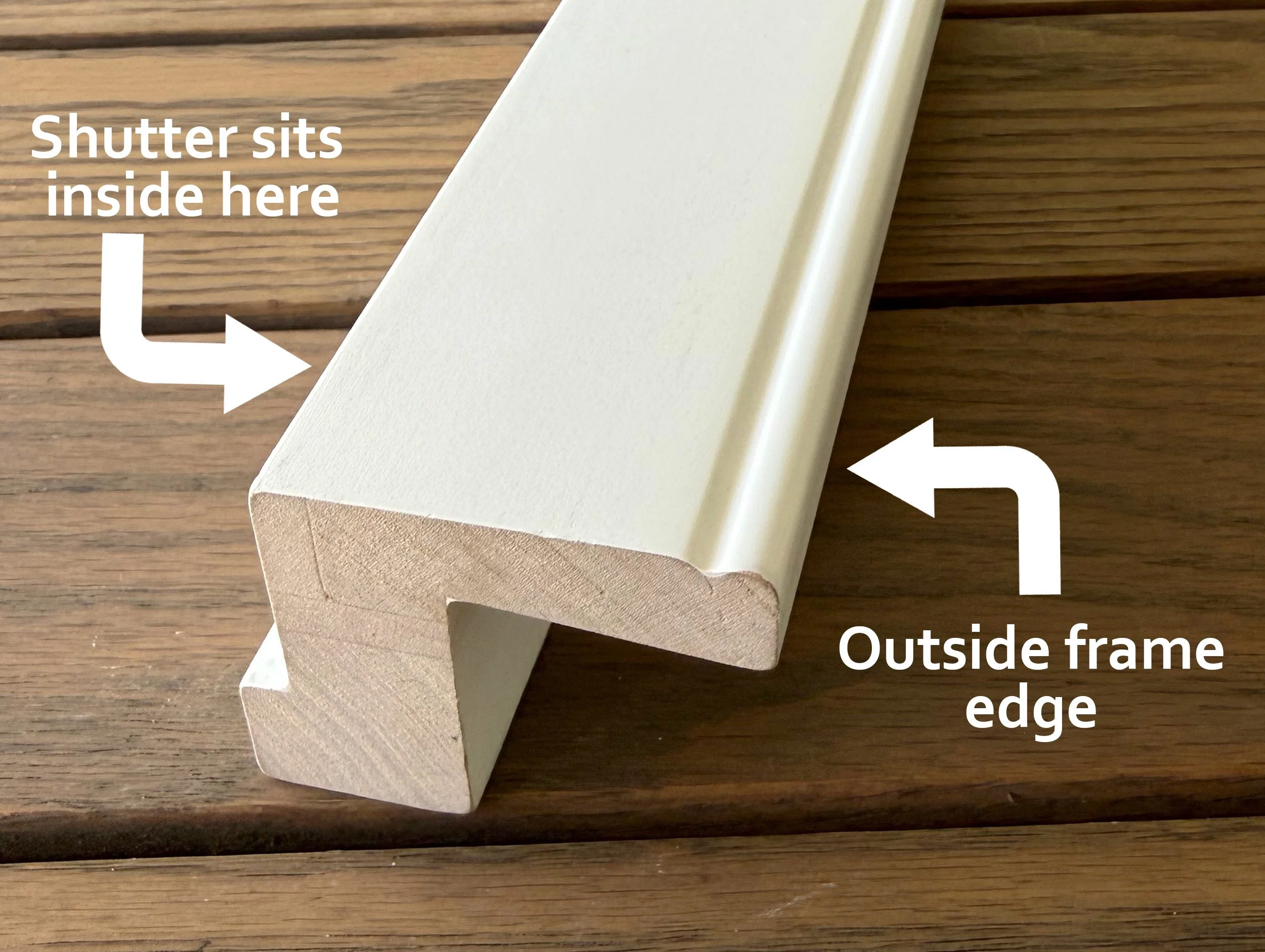
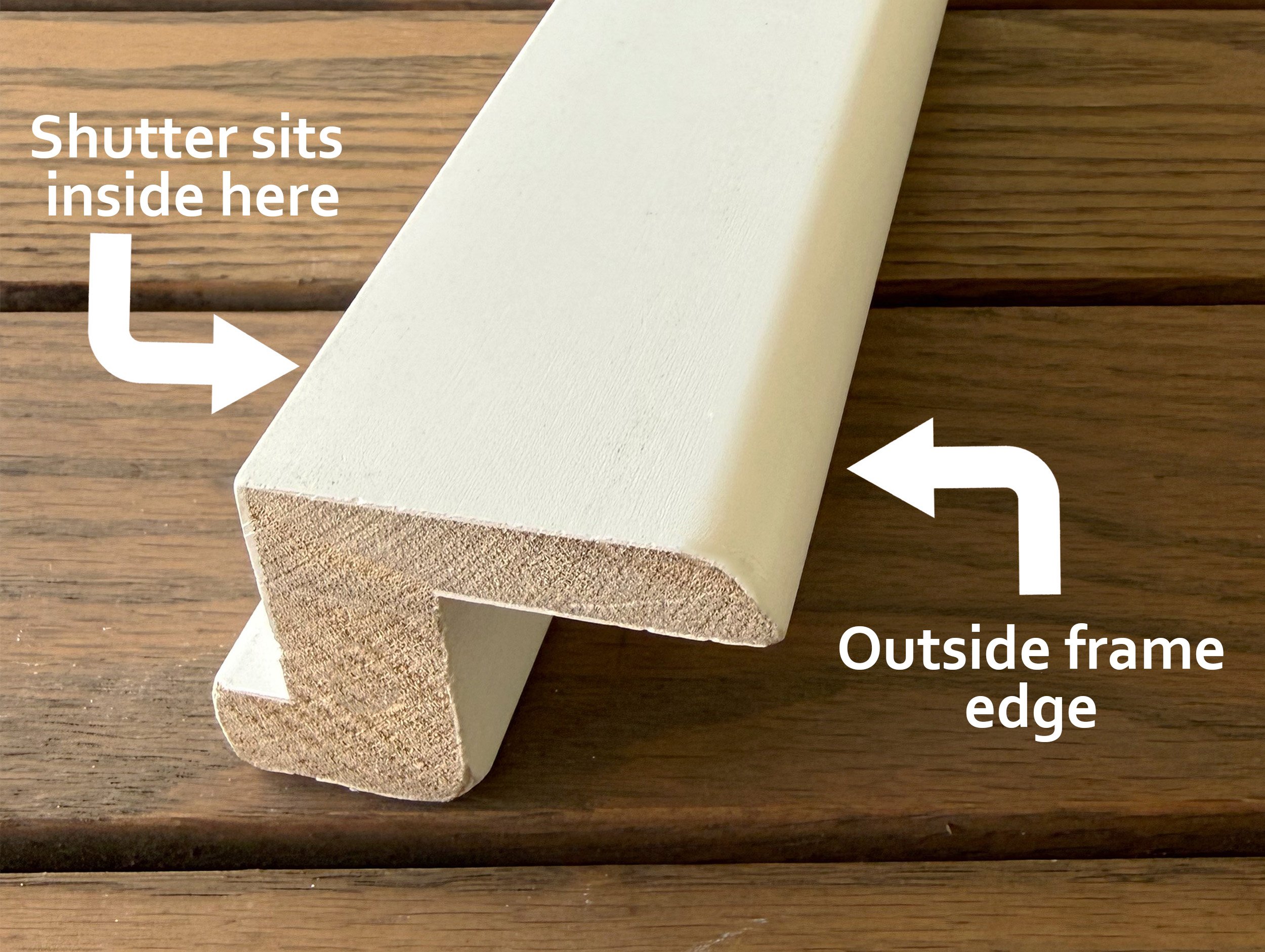
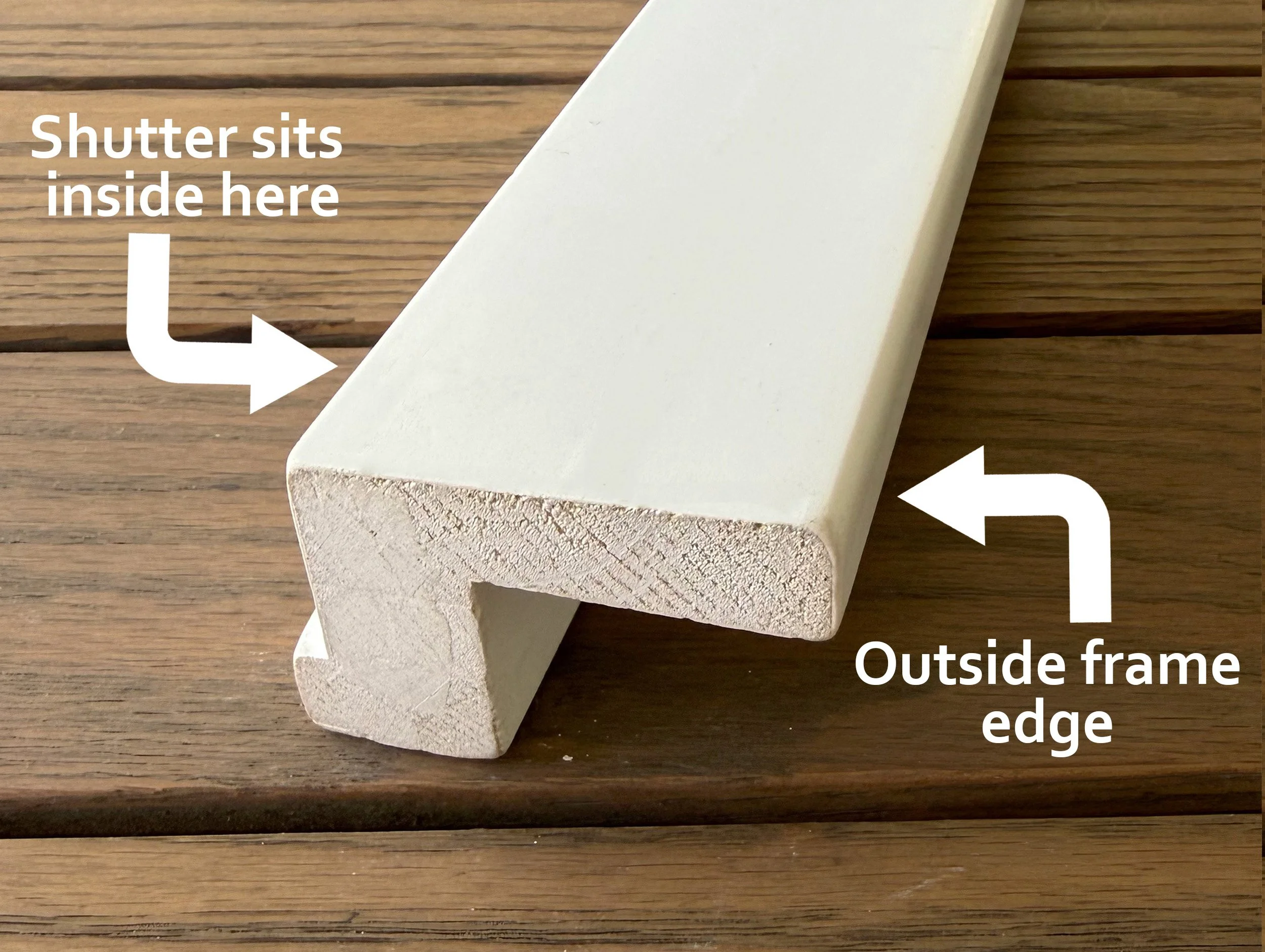
Our pick: An inside-mount frame (93% of our clients). The Modern and Traditional frame profiles are the most popular for drywall openings, while the L-Frame is best for trimmed openings - choose an outside-mount Deco or Flat frame to keep tilt-in windows working.
The frame is the trim that surrounds a shutter. Most Houston windows have a painted bottom sill with bare drywall on the other three sides, so we build a three-sided frame that covers the drywall edges and gives the window a finished, trimmed look. A window that's already trimmed on all four sides only needs a minimal 3/4" flat-faced "L-frame". We offer seven frame profiles, five inside-mount and two outside-mount. The right frame for your home is the profile whose face width and edge detail match your existing sill and trim (baseboard, crown molding, door trim, cabinets).
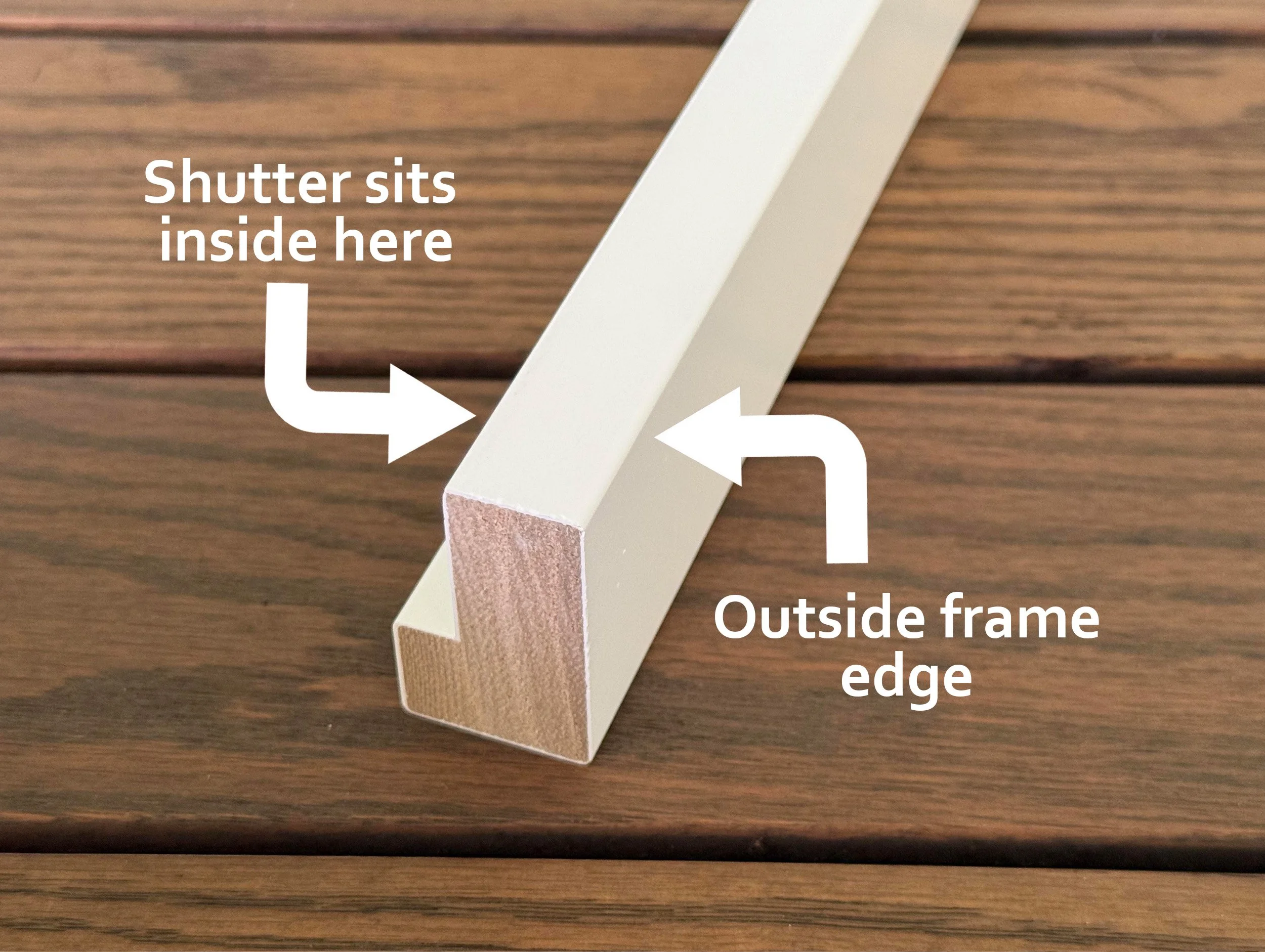
| Profile | Mount | Popularity | Face width | Edge detail | Best match | Feel |
|---|---|---|---|---|---|---|
| Traditional | Inside | 23% | 2.125" | Beaded | Common door trim and sill designs | Classic elegance |
| Modern | Inside | 26% | 2" | Flat, single outer bead | Newer sills and baseboards with simple beads | Refined minimalism |
| Southwestern | Inside | 7% | 2" | Bullnose outer edge | Flat sills with rounded edges | Soft simplicity |
| Craftsman | Inside | 12% | 2.25" | Completely flat | Flat sills and baseboard | Sharp squareness |
| L-Frame | Inside | 25% | 0.75" | Completely flat, slim | Windows that already have trim | Blends with existing trim |
| Deco | Outside | 3% | 1.625" | Decoratively beaded | Traditional sills; tilt-in windows | Ornately elegant |
| Flat | Outside | 4% | 1.625" | Completely flat | Modern sills; tilt-in windows | Sleek simplicity |

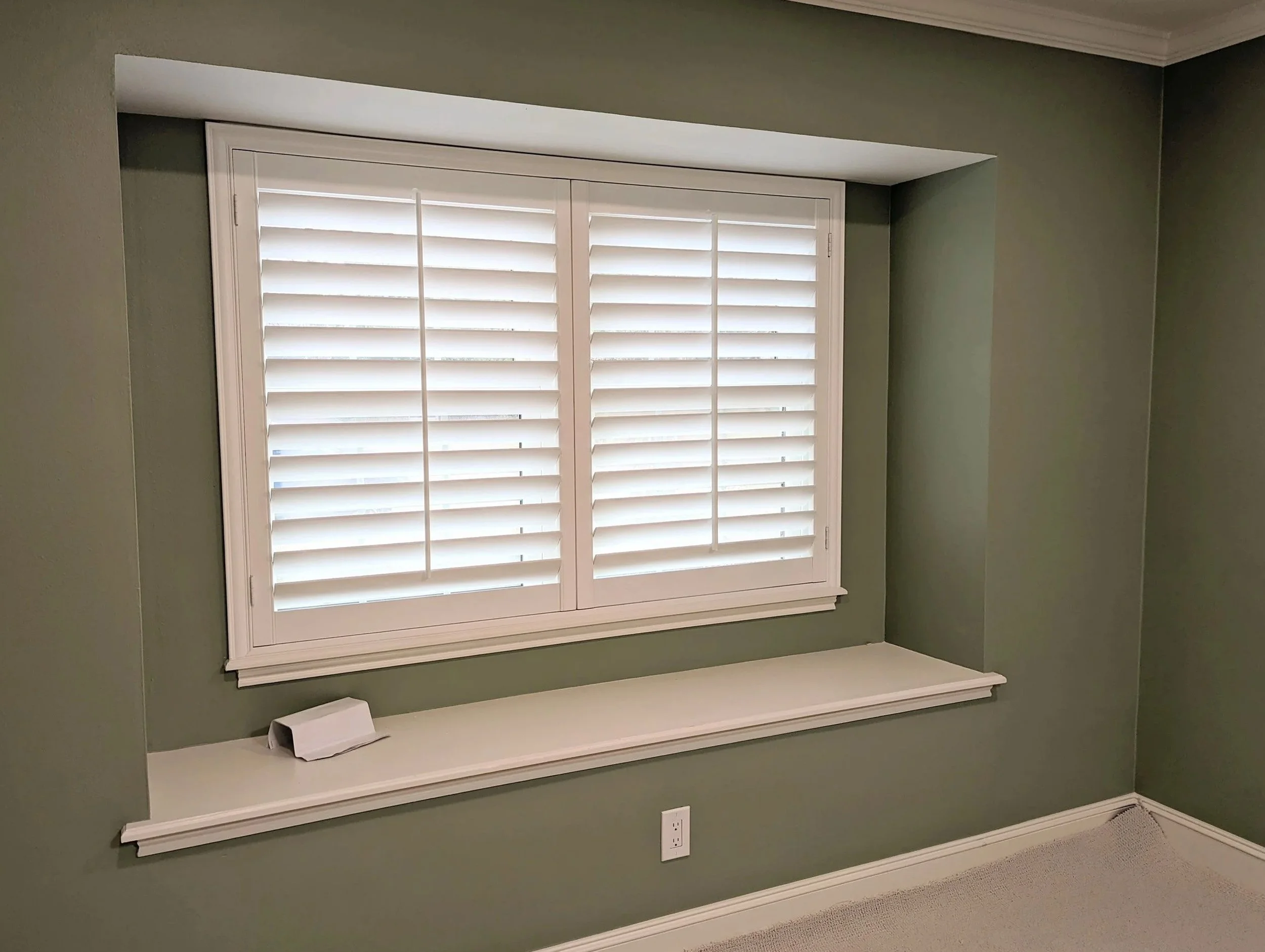
Single panels up to 39" wide — about 50% wider than poly
Our standard single wood panel is 39" wide (47" by exception), so a typical 35" window is built with one wood panel whereas poly shutters max out around 26" and require two panels.
Wood plantation shutters can be built in much wider panels than poly (composite) shutters, which means fewer vertical pieces interrupting your view. Every time a panel is added, you lose 4" of view directly in the center of your window. With wood you get fewer panels, wider louvers, a better view, easier cleaning, and fewer tilt rods to operate. Shutters with larger, continuous panels look cleaner, more modern and don't resemble "shutters of the past".
Compare wood and poly plantation shutter panel layouts.
39″ panel max
26″ panel max
Poly shutters are extruded PVC or a vinyl-wrapped composite. The material is considerably heavier than basswood and far less stiff, so past 26" a panel starts to sag on its hinges and the louvers bow in the middle. Manufacturers cap the width to avoid it. Solid hardwood is light and rigid, which is why our panels go to 39". On the same window that means fewer panels, wider louvers, fewer vertical sections interrupting the view, easier cleaning, and fewer tilt rods to adjust.
| Window Width | Wood (HTX) | Poly (Others) | View Saved |
|---|---|---|---|
| 36″ | 1 panel | 2 panels | 4″ |
| 72″ | 2 panels | 4 panels | 8″ |
| 105″ | 3 panels | 6 panels | 12″ |

Curved frames and panels with working louvers
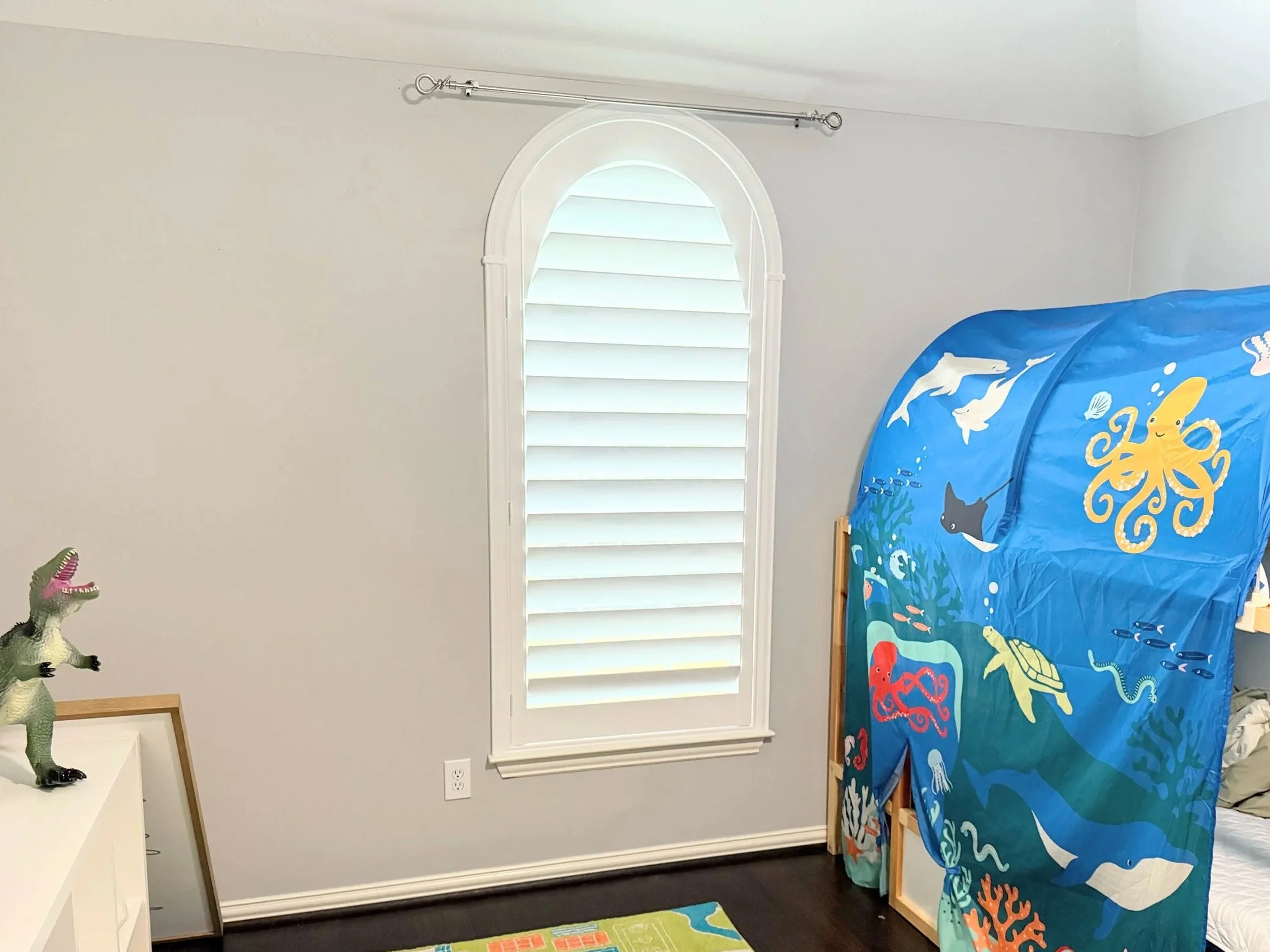
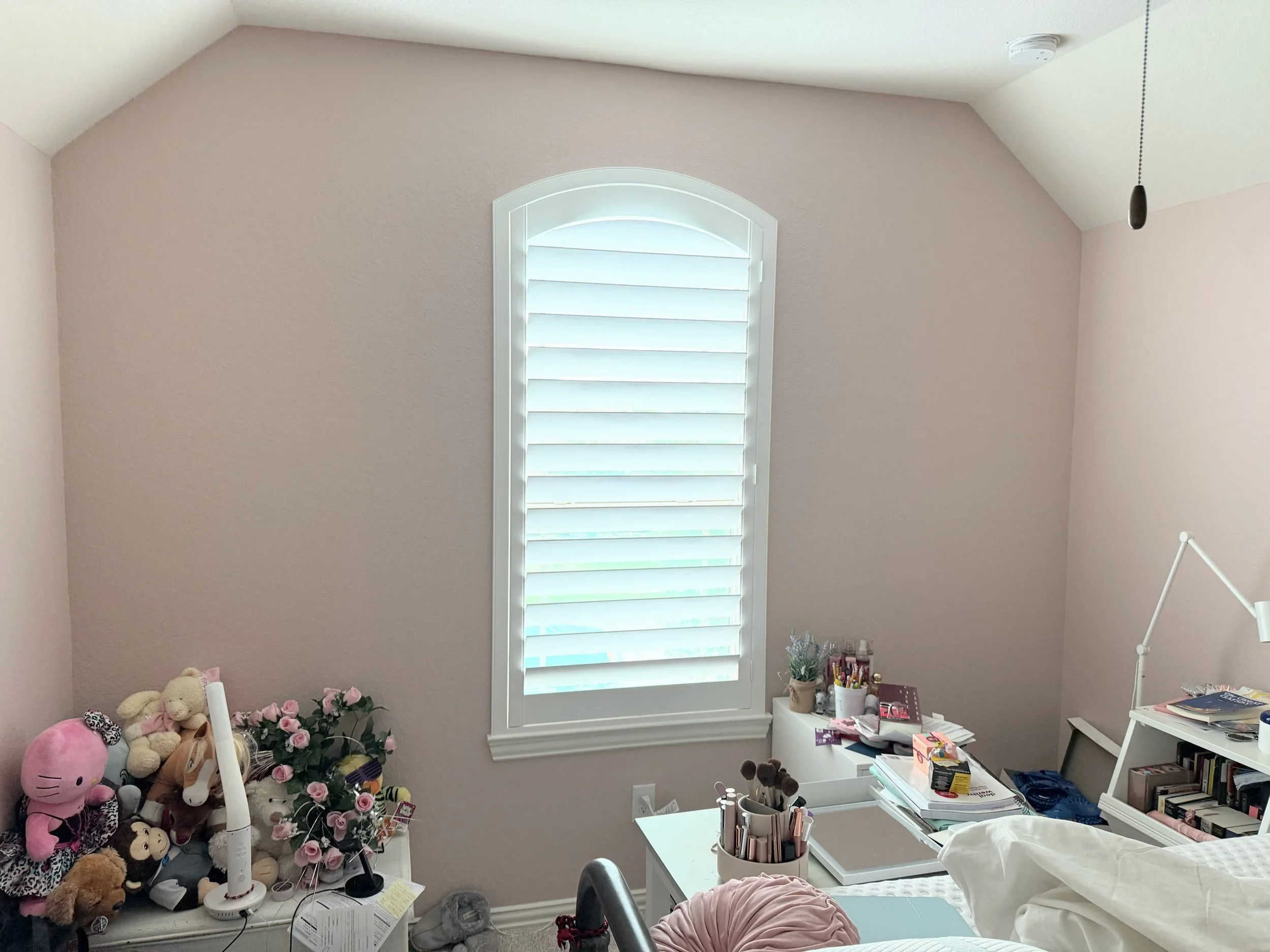
For arched windows we build an elegant curved frame with a curved, fully working louvered shutter panel - we avoid the radial "sunbursts" used by many manufacturers.
The curved shutter panel nests inside the curved frame, so the louvers stay functional all the way up through the arch instead of being fixed in the dated "sunburst" pattern. We apply that method to both "full" arches and "eyebrow" arches. Full arches have a full semicircle, whereas eyebrow arches have a curve with less slope. We typically come across more arches in homes in Friendswood, Pearland, Sugarland, Katy, Missouri City, Cypress and Spring.

Outside-mount frames that don't overhang the sill
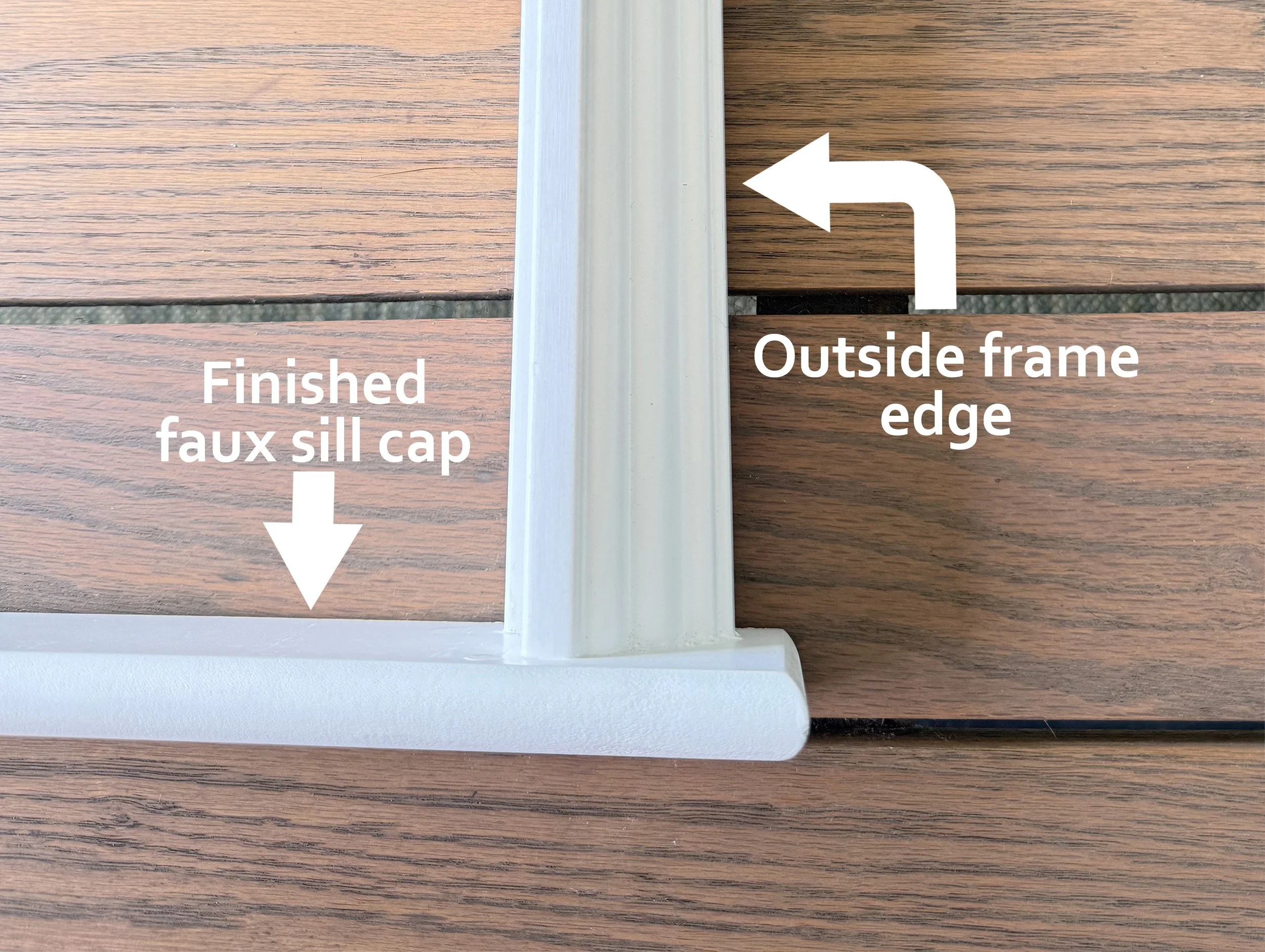
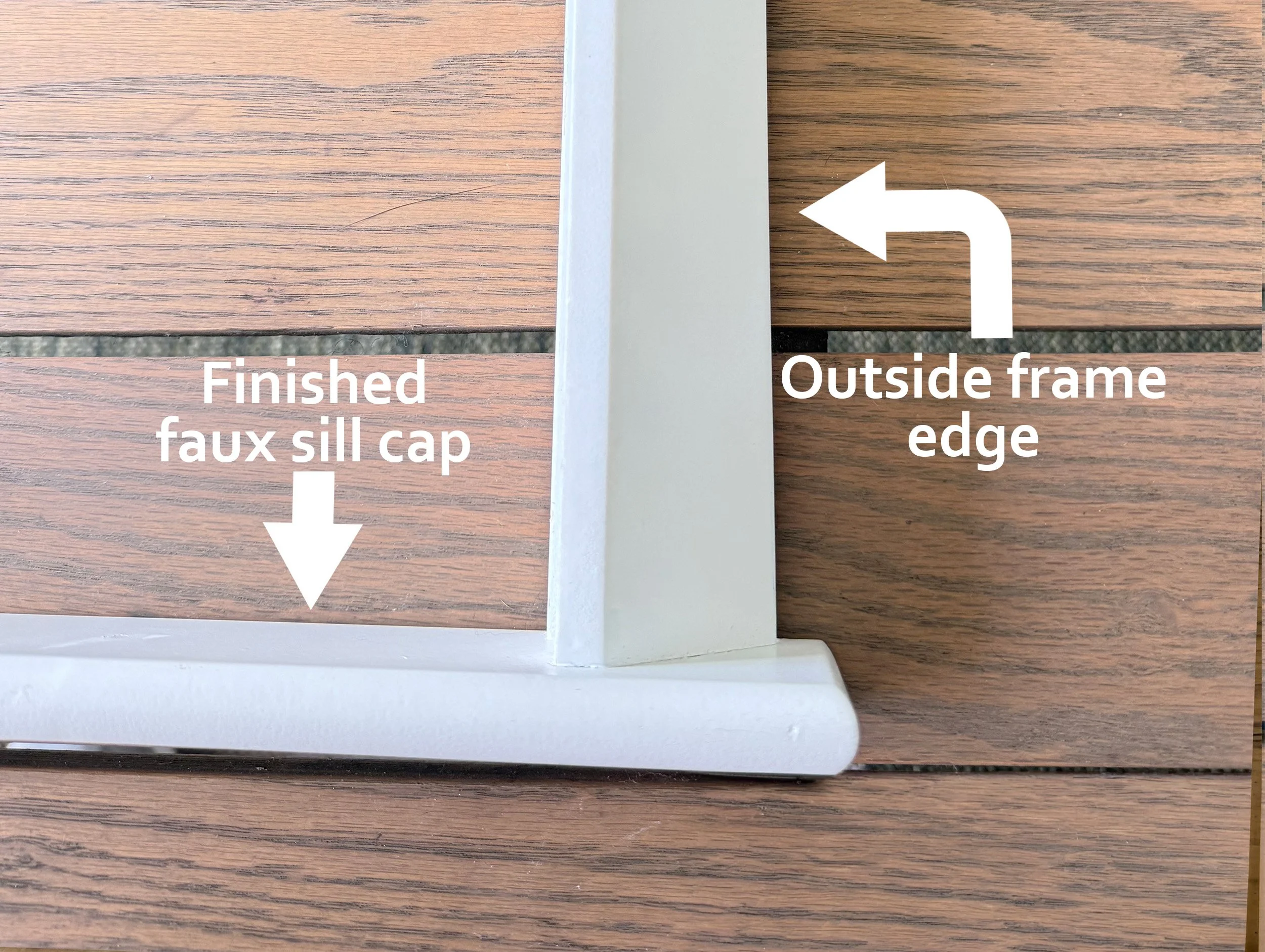
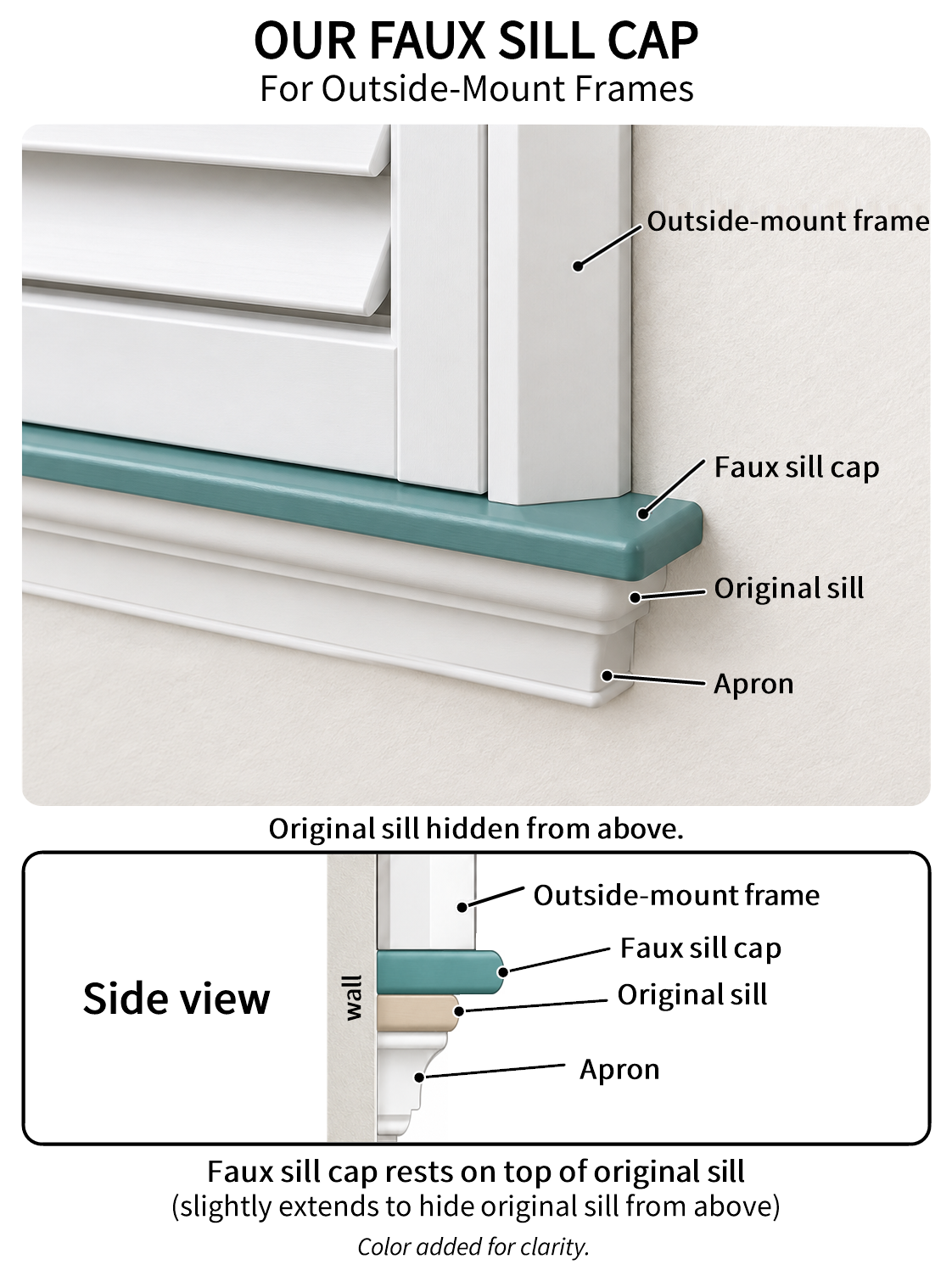
Our outside-mount frames sit on a faux sill cap that visually replaces your existing sill, so the frame appears as built-in trim instead of overhanging the sill like most outside-mount shutters.
The cap is a bottom piece that sits on top of your existing sill, so the frame doesn't stick out past it the way a standard outside mount does from other manufacturers (which looks like an afterthought). From most angles you can't tell it isn't part of the original trim, and the frame looks built-in rather than bolted on.
No fixed "dead" rail blocking the view
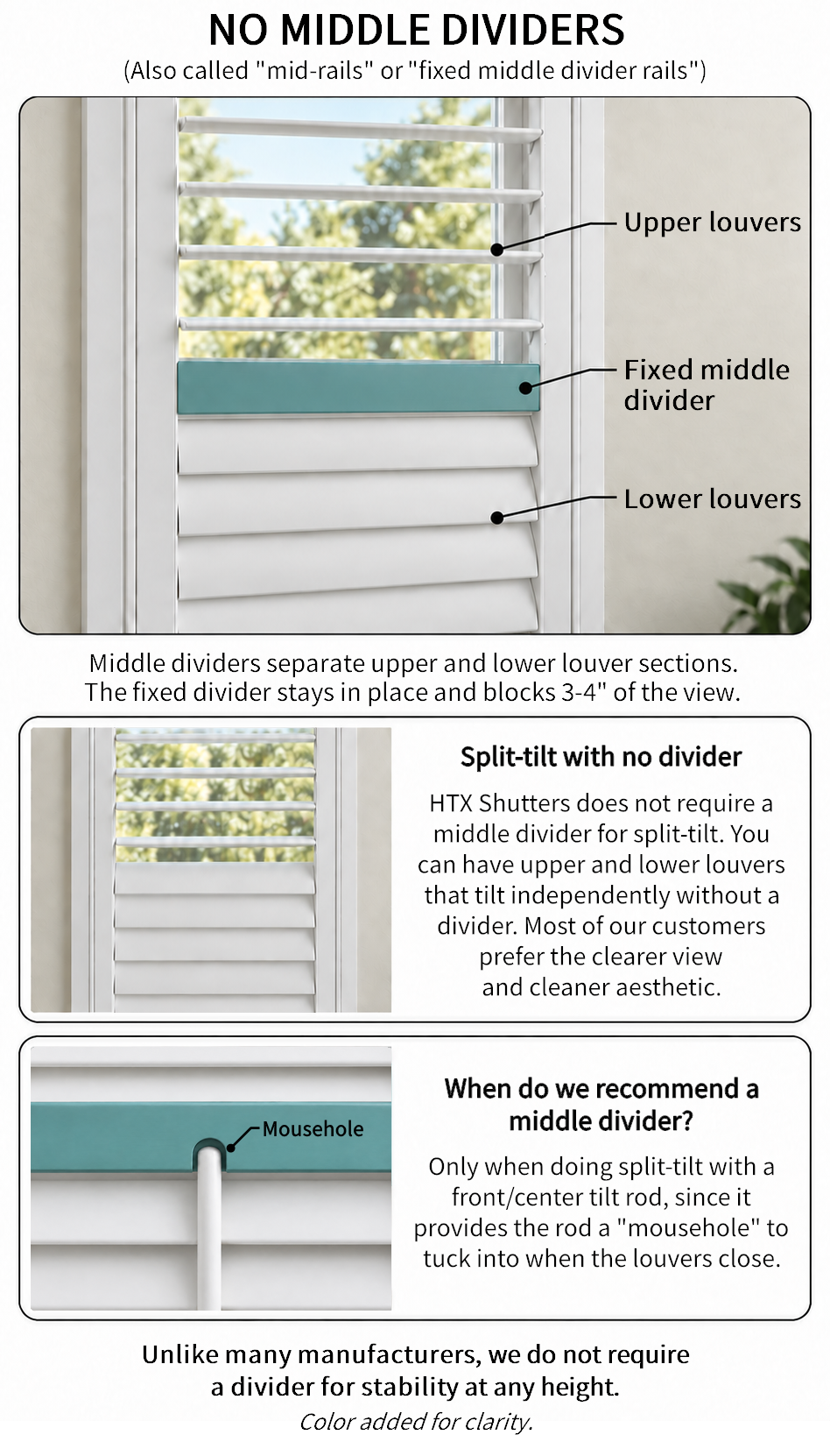
Our panels don't need the fixed 3"–4" divider rail most manufacturers use, so nothing permanently blocks the middle of your view; the only time we suggest one is split-tilt with a front/center tilt rod.
The divider rail is a solid section between the upper and lower louvers, which doesn't move, so on most manufacturers' shutters it permanently blocks part of the view. Our engineered panels are sturdy and stable without it. Not having the middle divider provides more flexibility with split-tilt, since you do not have to worry about a fixed "dead area" directly at your line-of-sight. With split-tilt and a front/center tilt rod, a divider keeps the upper and lower rods from clashing, which is why that is the one case we may suggest it.
Interlocking panels instead of a bulky cover strip
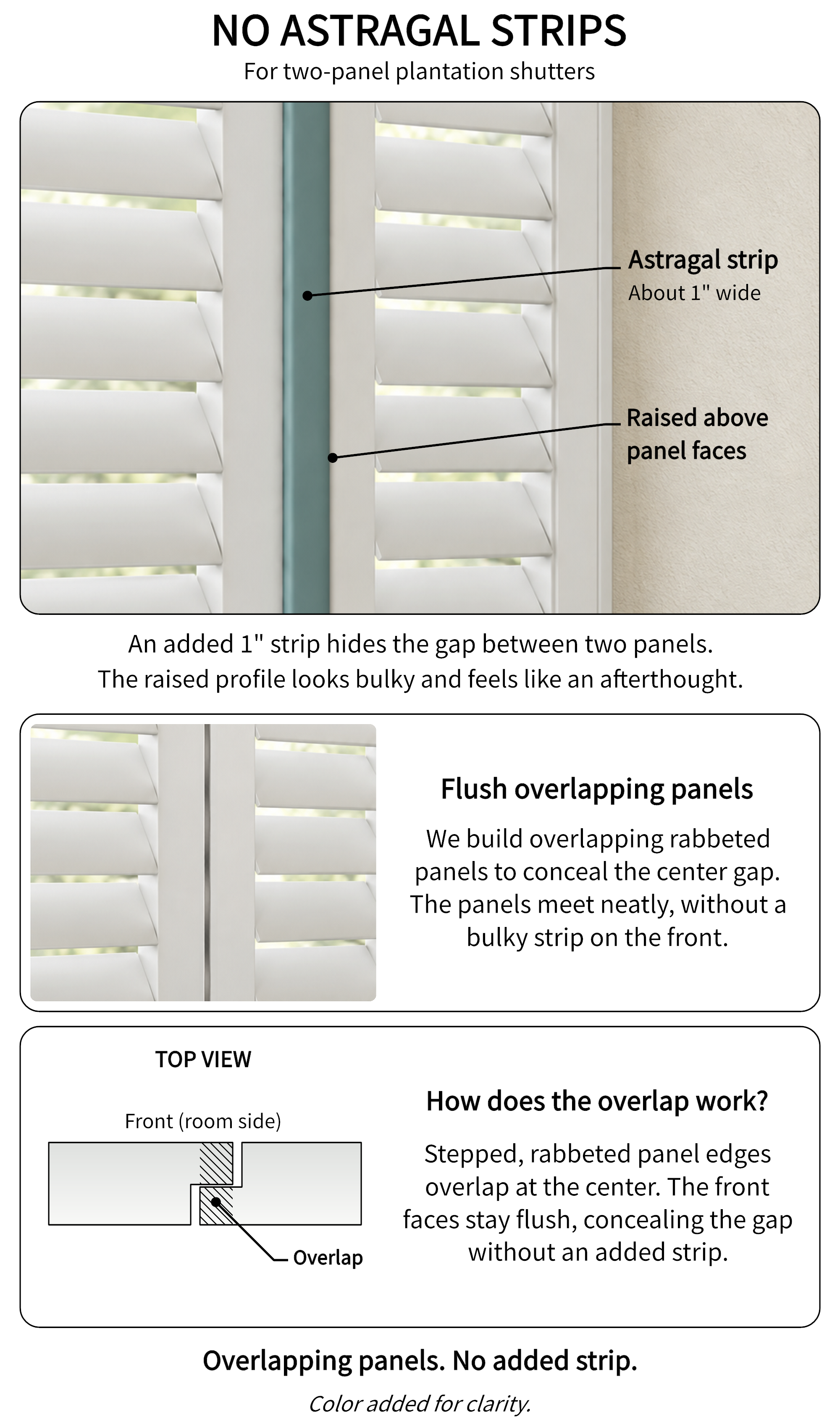
Our panels interlock where they meet, so there is no 1"-wide astragal strip covering a gap — a cleaner center line than most manufacturers deliver.
An astragal strip is an oversized strip that many manufacturers attach where two panels meet to hide a large gap. Interlocking panels close cleanly in the middle with only a small gap, so there is nothing to cover and no strip to add. Having no astragal strip also makes cleaning the shutter a little easier.
A printable walkthrough of the five styling decisions on this page, with diagrams and descriptions.

Download the HTX Shutters Style Guide (PDF)
Free · no email required
Every styling question we hear from Houston homeowners — louver sizes, split-tilt, frames, paint colors and panel configurations, answered by the people who build and install them.
The 4.5″ louver is our most popular size, used in 62% of homes. It has 33% fewer louvers than the 3.5″, giving a more open view and a modern, contemporary look. The 3.5″ (36% of homes) is more classic and traditional. We also offer a 2.5″ louver (2% of homes), mainly for the shallow window casings common in the Heights, Bellaire, and West University — though its look is more historic and looks more at home in formal settings.
Yes — bigger louvers mean fewer slats blocking your view. Every louver edge is 0.47″ thick regardless of size, so the view you lose depends on how many louvers the window needs. Take a 70″ tall window: 3.5″ louvers require 20 slats, while 4.5″ louvers need just 15 — about a third fewer. Those 20 slats block 9.4″ of the view (20 × 0.47″); the 15 larger slats block only 7.05″. That's 2.35″ more open glass with the 4.5″ louvers — roughly 3.4% of the whole window.
No — 4.5″ louvers look great on small windows. With 33% fewer slats than the 3.5″, they maximize view and light exactly where glass is limited. A 3.5″ can appear slightly more proportional, but at the cost of more obstruction.
Wide openings — we regularly build for ~94″, ~105″, even 142″ windows — become 3-, 4-, 5-, or 6-panel configurations. We divide the frame with 1″ T-posts aligned to your window’s natural breaks, so the shutter layout mirrors the window itself.
Because the front tilt rod is the most common failure point on any plantation shutter. We steer most customers to our hidden/rear tilt system, which has no maintenance or longevity issues and is warrantied for life; front-tilt staple separation is covered for 12 months. We mainly use front tilt rods in historic areas like the Heights, Bellaire and West University, where the traditional look fits. This amounts to about 8% of our customer-base.
Split-tilt divides a shutter’s louvers into a top set and a bottom set that operate independently — close the bottom for privacy while the top stays open for sunlight. Common configurations are a 50/50 split or 33% top / 67% bottom, and unlike many companies, our design requires no fixed 3–4″ divider rail that blocks your view. The split can also be aligned to a window’s horizontal break, most commonly about 30″ up from the bottom, but splitting at "break" is typically too low to provide any real privacy or sun-control.
Decide window by window — not every window needs split-tilt. We commonly use 33/67 in bedrooms for extra privacy and 50/50 where privacy matters less. For small windows, sidelights, and doors, clients usually skip split-tilt. While 33/67 splits work well with mid-to-tall sized windows, applying a 33/67 split on a smaller height window can result in only a few louvers for the top set. This typically doesn't look as good, and shutters function better with at least three or four louvers on each set. Seven factors worth considering for split-tilt: window height, height off the floor, privacy needs, sitting vs. standing rooms, occupant heights, neighboring homes’ vantage points, and existing privacy from trees or fences.
The asymmetrical layout of the 33/67 is the most modern, as it strays from rigid, traditional rules of formal balance. A 50/50 split is less modern than the 33/67 split, but it is certainly more modern than placing the split at the "break" in combination with a divider rail.
No — split-tilt is free on any window. So are louver size, light Sherwin-Williams paint colors, tilt-rod style, and frame selection.
Inside-mount frames, for about 93% of installations. Inside-mount frames wrap the edge of the window casing, protrude less from the wall, and look integrated and built-in — though they block a window’s tilt-in cleaning function. Outside-mount frames sit on the drywall face, protrude further, and preserve tilt-in function; we recommend them mainly for 2+ story homes where upper windows are hard to clean. Some competitors push outside mounts simply because they’re easier to measure for and install.
Five inside-mount profiles and two outside-mount profiles, ranging from classic to modern:
We build true arched plantation shutters with functional louvers all the way through the curve, framed by matching curved frames. Arched shutters typically add $200 for narrower windows to $450 for wider windows more than a rectangular shutter. We find this more timeless and elegant than sunburst/radial-style shutters.
Our favorites are Sherwin-Williams “High Reflective White” SW7757 and “Extra White” SW7006 — clean, bright, cool whites. Customer favorites also include “Snowbound” SW7004, “Pure White” SW7005, and the warmer “Alabaster” SW7008. Every order includes one custom light color (any Sherwin-Williams white, light beige, or light gray) in industrial-grade paint. When torn between two shades, go lighter — “lighter is brighter,” and it lifts the whole room.
A low-gloss sheen closest to satin. Shutters present a large surface that loves to bounce light, so low gloss cuts glare — and it hides minor surface imperfections better than a medium sheen or a semi-gloss would.
Every added panel costs roughly 15% of your view, so we build windows up to 39″ wide as one panel and up to 78″ as two panels (single panels to 47″ by exception). Our customers usually find that fewer panels gives a cleaner, more modern look - whereas too many panels can make shutters feel dated or too traditional. Prefer the multi-panel look? We’re happy to build it — additional panels are $95/panel on standard window sizes.
No — nearly every home ends up with a natural mix. Windows under 39″ default to one panel and windows over 39″ to two or more, and because individual panel widths stay similar across many configurations, the result looks balanced and preserves the view. If you choose two panels on a sub-39″ window, it is common to keep that configuration consistent on same-size windows in the room or line of sight.
Yes — about 25% of our customers with curtains keep them with shutters. The one rule: curtain hardware brackets can’t cover the first 2″ border around the top of the window opening.
We build black shutters, but recommend them selectively with realistic expectations for up-keep. Dark paint carries a surcharge (3–5 coats for full coverage), any scratch quickly reveals the white primer beneath, and black shows dust far more than any other color — expect a constant cleaning battle.
No — we believe natural light is healthy and necessary. Cover only the windows with a real privacy or sun-control need. Upper transoms (above living room windows, primary bedroom windows, or the front door) are the most common judgment call, and it’s a personal one. On many homes, the window above the bathtub in the primary bedroom is often frosted/opaque, so many people will leave that open as well. Others will cover it for styling continuity and assistance with heat prevention.
Have a different question? Browse all 111 plantation shutter answers.
Read about materials or installation methods.